
The Growing Burden of High-Interest Consumer Debt: Why Your Low-Rate Mortgage Isn’t Enough
For many homeowners in Johnson City, TN, and across the nation, the current financial landscape presents a unique paradox. You might be sitting comfortably in a home with a historically low mortgage rate—perhaps locked in at 3% or 4% from a few years ago. On paper, this looks like a financial win. You have what the industry calls “golden handcuffs.” You feel you can never sell or refinance because you don’t want to lose that incredible rate.
However, there is a silent crisis brewing in many of these same households. While the mortgage rate is low, consumer debt is climbing. It is not uncommon for families to carry $25,000, $50,000, or even over $100,000 in high-interest credit card debt, personal loans, and auto loans. When you combine a 3% mortgage with credit card balances charging 22% to 29% interest, the “low rate” victory starts to feel like a defeat.
At The Arrowood Team, led by Tim Arrowood, we believe in looking at the whole financial picture, not just one interest rate. In this post, we will explore why your low mortgage rate might not be enough to protect your financial future if high-interest debt is weighing you down, and how strategic refinancing can unlock true financial freedom.
The “Golden Handcuffs” Dilemma: Rate vs. Cash Flow
The term “Golden Handcuffs” refers to the psychological barrier preventing homeowners from refinancing or moving because they are attached to their current low interest rate. It is understandable; trading a 3.5% rate for a market rate that is higher seems counterintuitive.
However, this mindset ignores a critical factor: Blended Rate and Monthly Cash Flow.
If you are struggling to make minimum payments on credit cards, or if your disposable income is vanishing every month due to servicing consumer debt, your low mortgage rate is not saving you money—it is merely a single variable in a much more expensive equation. Inflation has driven up the cost of living in the Tri-Cities area, and when combined with variable high-interest debt, many families are finding themselves “house rich” but “cash poor.”
The Reality of Consumer Debt Interest
Unlike mortgage interest, which is often tax-deductible and relatively low, consumer debt is toxic to wealth building. Consider the current landscape:
- Credit Cards: Average rates are hovering between 20% and 29%.
- Personal Loans: Often range from 10% to 18%.
- Auto Loans: Rates have risen significantly, increasing monthly obligations.
When you carry a $50,000 balance across these high-interest accounts, the compound interest works against you aggressively. By holding onto a low mortgage rate while servicing high-interest debt, you are effectively stepping over dollars to pick up pennies.
The Math: Why Your “Low Rate” Might Be Costing You More
Let’s look at the numbers. This is where the concept of a Blended Rate becomes essential. Your blended rate is the weighted average interest rate of all your debt (mortgage + consumer debt).
Below is a hypothetical comparison for a homeowner in Johnson City.
Comparison: The “Low Rate” Trap vs. The Consolidation Strategy
Financial Scenario Current Situation (The Trap) New Strategy (Cash-Out Refinance) Mortgage Balance $300,000 $380,000 (Includes debt payoff + closing costs) Mortgage Rate 3.25% 6.50% (Hypothetical Market Rate) Consumer Debt $80,000 (Credit Cards/Autos) $0 (Paid off at closing) Consumer Debt Rate 24% (Average) N/A Monthly Mortgage Payment (P&I) $1,305 $2,402 Monthly Debt Payments $2,200 (Min payments) $0 Total Monthly Outflow $3,505 $2,402 Monthly Savings $0 $1,103 Saved Per Month
*Note: This is a hypothetical scenario for educational purposes. Rates and terms vary based on credit profile and market conditions. Contact Tim Arrowood for a personalized analysis.
In this scenario, even though the homeowner increased their mortgage rate from 3.25% to 6.50%, they saved over $1,100 per month in cash flow. Furthermore, the interest on the new loan is likely tax-deductible (consult your tax advisor), whereas the credit card interest was not.
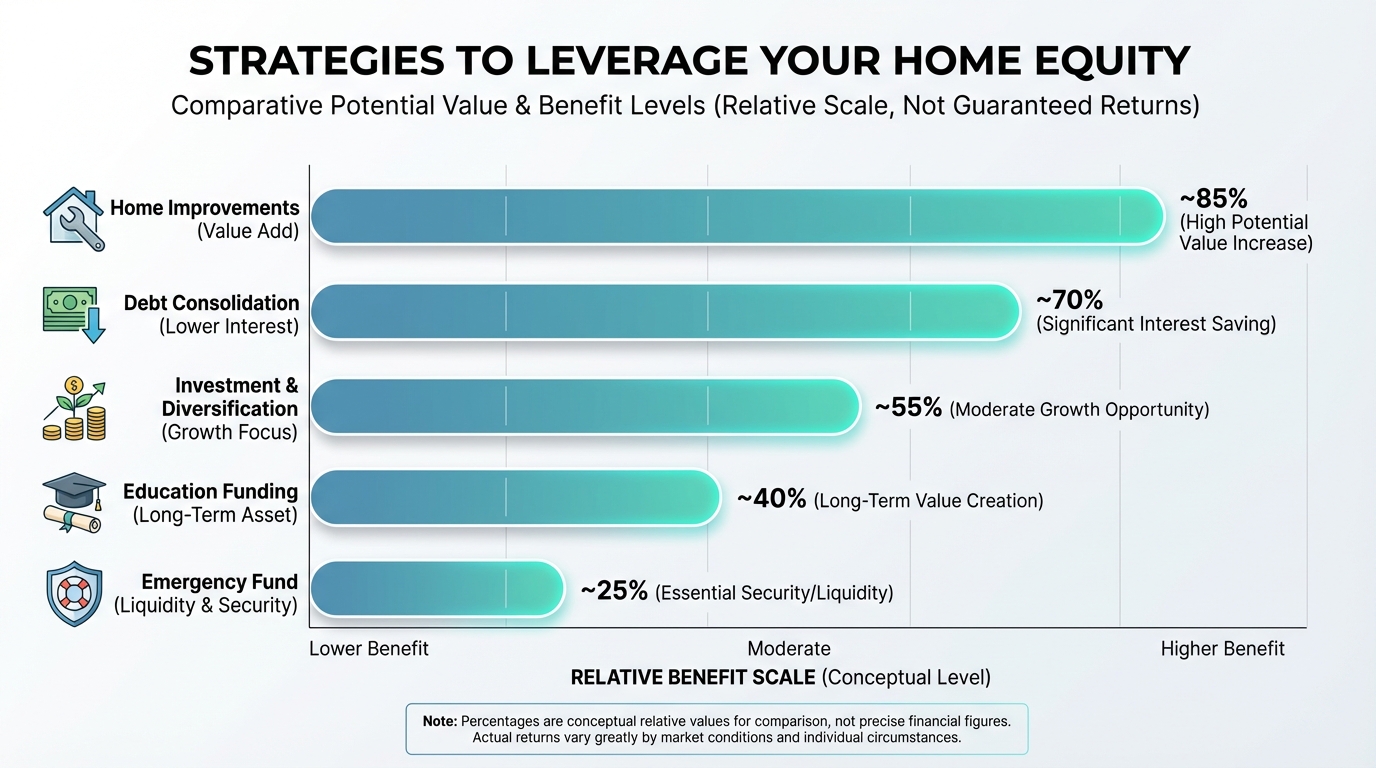
Strategies to Leverage Your Home Equity
Home values in Johnson City and the surrounding Tri-Cities area have seen significant appreciation over the last few years. This equity is a powerful tool. Here is how you can use it to eliminate the burden of high-interest debt.
1. Cash-Out Refinance
This involves replacing your current mortgage with a new one for a higher amount than you currently owe. The difference is given to you in cash, which The Arrowood Team directs toward paying off your high-interest creditors.
Pros: Simplifies finances into one payment; potential tax benefits; significantly lower interest rate compared to credit cards.
Cons: You lose your current low rate; restarts the amortization clock (though terms can be adjusted).
2. Home Equity Line of Credit (HELOC)
Pros: You keep your first mortgage rate.
Cons: HELOC rates are variable (often Prime + Margin), meaning your payment can rise; interest rates are currently higher than first mortgage rates.
3. Fixed-Rate Second Mortgage (Home Equity Loan)
Similar to a HELOC, but you receive a lump sum with a fixed interest rate. This allows you to keep your primary mortgage intact while consolidating debt at a rate lower than credit cards.
Why Local Expertise Matters in Johnson City
Real estate and lending are hyper-local. When considering restructuring your debt, you need a partner who understands the Johnson City, TN market. Automated online lenders often miss the nuances of local property values or unique borrower situations.
Tim Arrowood and The Arrowood Team at Preferred Rate take a consultative approach. We don’t just quote a rate; we perform a Total Cost Analysis. We look at:
- Your short-term and long-term financial goals.
- Your break-even point.
- How much equity you have available based on local appraisals.
- Your “Blended Rate” to ensure the move makes mathematical sense.
We understand that debt can be stressful. Our goal is to move you from a position of stress to a position of stability and growth.
Is Now the Right Time to Break the Glass?
Waiting for interest rates to drop back to 3% may be a waiting game that lasts for years—or forever. In the meantime, paying 25% interest on $50,000 of debt is eroding your net worth every single day.
If you are making minimum payments, you aren’t just stuck; you are sliding backward. Utilizing your home equity to consolidate debt is not about “losing” a good rate; it is about gaining control of your cash flow. Imagine what you could do with an extra $1,000 or $1,500 per month. You could rebuild your savings, invest for retirement, or simply breathe easier.
Frequently Asked Questions (FAQs)
1. Will refinancing to pay off debt hurt my credit score?
Initially, you may see a small dip due to the credit inquiry and the new loan opening. However, paying off maxed-out credit cards significantly lowers your credit utilization ratio, which is a major factor in credit scoring. Many clients see their scores improve shortly after consolidation because their utilization drops to zero.
2. Can I do a cash-out refinance if I have bad credit?
FHA and VA loans offer flexible guidelines for cash-out refinances, often allowing for lower credit scores than conventional loans. The Arrowood Team specializes in finding solutions for various credit profiles. It is best to call us for a specific review of your situation.
3. How much equity can I take out of my home in Tennessee?
Generally, for a conventional cash-out refinance, you can borrow up to 80% of your home’s value. For VA loans (available to eligible veterans and active duty), you may be able to go up to 90% or even 100% in certain scenarios. FHA loans typically allow up to 80%.
4. Is a HELOC better than a full refinance?
It depends on the amount of debt and your risk tolerance. If you have a small amount of debt, a HELOC might be better to preserve your primary rate. However, if you have significant debt ($50k+), the variable rate of a HELOC can be risky, and a fixed-rate cash-out refinance often provides more stability and monthly savings.
5. How long does the refinance process take with The Arrowood Team?
While industry averages can vary, we pride ourselves on efficiency. Typically, a refinance can close in 30 days or less, provided all documentation is submitted promptly. We have a “Closing Guarantee” that reflects our commitment to getting you to the finish line on time.
Take Control of Your Financial Future Today
Do not let a low interest rate on your mortgage blind you to the high cost of your consumer debt. The “Golden Handcuffs” don’t have to be permanent. If you are carrying high balances on credit cards or personal loans, let’s run the numbers together.
Tim Arrowood and The Arrowood Team are here to help you evaluate your options with transparency and care. We serve Johnson City and the greater Tennessee area with pride.
Ready to see how much you can save?
Click here to visit The Arrowood Team or call us directly at (423) 406-1567 to schedule your free debt consolidation consultation.
The Arrowood Team | Preferred Rate. Tim Arrowood, NMLS # [Insert NMLS ID]. Preferred Rate is a division of American Pacific Mortgage Corporation NMLS #1850. All rights reserved. This is not a commitment to lend. All loans subject to credit approval. Rates and fees subject to change. Equal Housing Lender.
Disclaimer: The financial scenarios provided in this article are for educational purposes only and do not constitute financial advice. Please consult with a qualified mortgage professional to discuss your specific situation.
Related guides from The Arrowood Team
- Debt Consolidation Refinance in Johnson City, TN
- Your Guide to a Debt Consolidation Mortgage in Johnson City, TN
- Why Homeowners Need a Debt Manager, Not Just a Lender
- The Ultimate Guide to Refinancing Your Mortgage in 2026: Timing, Benefits, and Strategies Amid Stabilizing Rates
Ready to move forward? Start your application or see how the $5,000 Closing Guarantee strengthens your offer.
